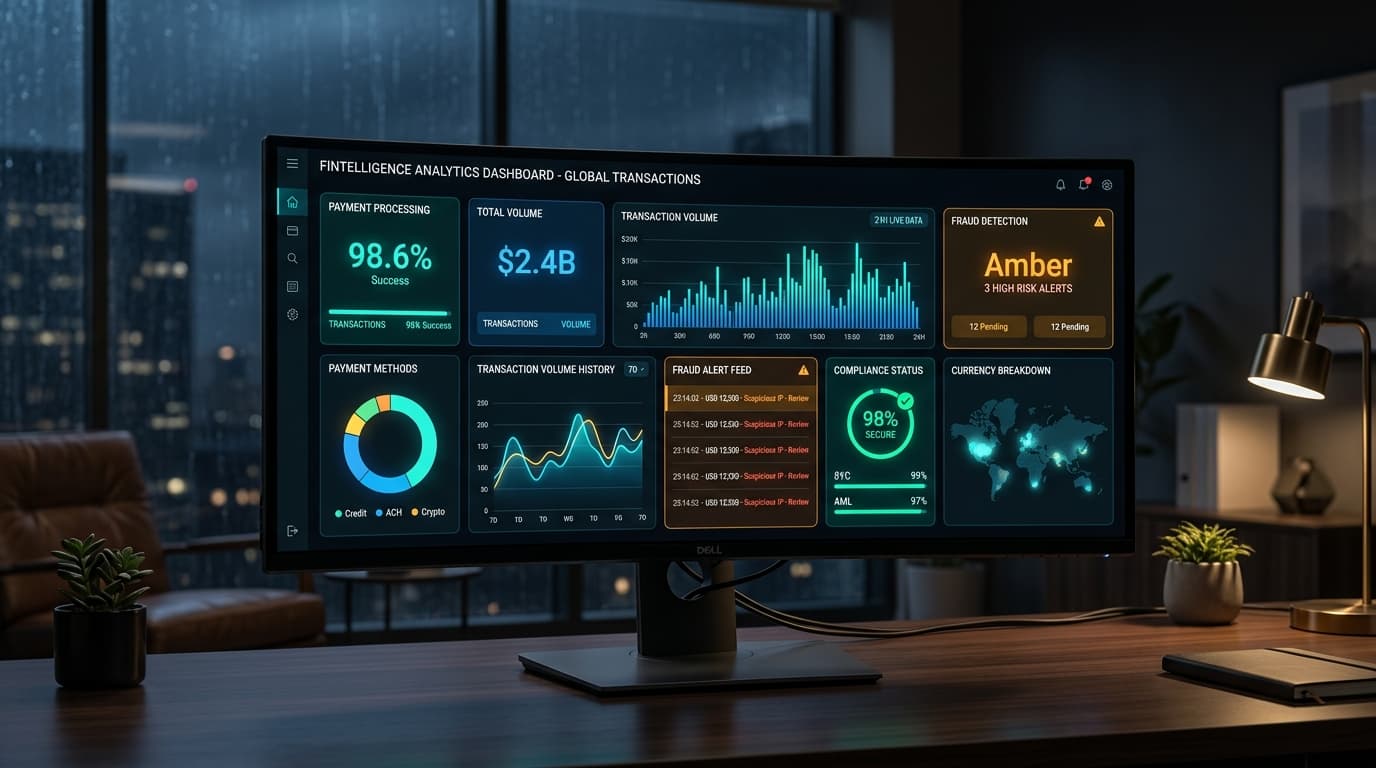
AI Fraud Detection & Intelligent Automation
Fraud losses and manual review queues both eat margin. Hurain Technologies builds AI-driven fraud detection, transaction monitoring, and workflow automation systems for payments and fintech platforms — real-time risk scoring, anomaly detection, and automated case management that reduce loss without adding friction for good customers.
Overview
What ai fraud detection & intelligent automation actually involves
The hardest part of fraud detection isn't catching fraud — a system tuned aggressively enough will catch nearly all of it. The hard part is catching fraud without also blocking the much larger volume of legitimate customers whose behavior happens to look unusual for a moment. A rules engine tuned for maximum fraud capture typically drives false-positive rates high enough to create real revenue loss and customer frustration from good transactions getting declined, which is why the actual engineering problem is precision, not just recall.
We approach this as a hybrid problem rather than a pure machine-learning one: proven rules stay in place for known fraud patterns where a rule is genuinely the right tool, and machine learning models handle the adaptive, harder-to-specify patterns that rules can't keep up with as fraud tactics evolve. Every model we deploy first runs in shadow mode — scoring live traffic without actually blocking anything — so we can validate precision and recall against real data before a single legitimate customer is ever affected by an automated decision.
The Challenge
Problems we see teams struggling with
Fraud losses outpacing rule-based systems
Static rule engines can't keep up with evolving fraud patterns, leading to rising chargeback and loss rates.
Manual review bottlenecks
Investigation teams drown in false positives, slowing down legitimate customers and burning analyst hours.
No real-time visibility into risk
Batch-based monitoring catches fraud after the money has already moved.
Repetitive manual operations
Reconciliation, reporting, and case triage consume hours that could be automated.
Model drift going undetected
Fraud patterns evolve, and a model that isn't monitored and retrained regularly quietly loses accuracy until losses spike and someone finally investigates why.
No feedback loop from investigator decisions
When analyst outcomes aren't fed back into the model, the system never learns from the cases your own team has already correctly resolved.
Our Approach
How Hurain Technologies solves it
Real-time transaction monitoring
Stream-processing risk engines that score transactions in milliseconds, not batch cycles.
Machine learning risk scoring
Supervised and unsupervised models trained on your transaction patterns, continuously retrained as fraud tactics evolve.
Anomaly & behavioral detection
Device fingerprinting, velocity checks, and behavioral biometrics layered on top of traditional rules.
Automated case management
Risk-ranked case queues that route only genuine high-risk cases to human analysts.
AML/KYC workflow automation
Automated sanctions screening, PEP checks, and suspicious activity report generation.
Operational workflow automation
RPA and orchestration for reconciliation, reporting, and other repetitive back-office processes.
Continuous model monitoring and retraining
Automated drift detection and a scheduled retraining pipeline that feeds investigator decisions back into the model, so it improves rather than silently decaying.
Technology
Tech stack we work with
ML & Data
Streaming
Backend
Automation
Real-time scoring requires a streaming architecture, not a batch one — transactions are scored in milliseconds as they happen, using a feature store that pre-computes behavioral signals (transaction velocity, device history, geographic consistency) so the model doesn't have to calculate them from scratch on every request. We build this on Kafka and Flink for the streaming layer, with a feature store keeping both real-time and historical features available to the model with consistent definitions on both sides.
Explainability is built into the model architecture, not added afterward as a reporting layer: every flagged transaction carries the specific contributing factors and their relative weight in the decision, not just a risk score. This matters for two reasons — investigators can triage faster when they know why something was flagged, and regulators reviewing your program can see a clear, defensible reasoning trail rather than a black-box score they have to take on faith.
Use Cases
Where ai fraud detection & intelligent automation gets used
Real-time payment fraud scoring
Millisecond transaction risk scoring integrated directly into the payment authorization flow, not a post-hoc batch review.
Account takeover detection
Behavioral biometrics and device fingerprinting that catch a compromised account being used by someone other than its owner.
AML transaction monitoring
Pattern detection tuned to structuring, layering, and other money-laundering behaviors, separate from card-fraud-specific models.
Chargeback and dispute reduction
Risk scoring applied specifically to reduce the transactions most likely to result in a costly chargeback down the line.
Automated case triage for investigation teams
Risk-ranked queues that route only genuinely high-risk cases to human analysts, instead of an undifferentiated alert firehose.
Back-office workflow automation
RPA and orchestration for reconciliation, reporting, and other repetitive operational processes beyond fraud specifically.
Proof
Results we've delivered
Client Result
A payments platform was losing 1.8% of transaction volume to fraud with a legacy rules engine generating an 11% false-positive rate. Hurain Technologies deployed a hybrid ML/rules risk engine, cutting fraud losses by 62% while reducing false positives to 3.4%, freeing the review team to focus on genuine risk.
Process
How an engagement runs
- 1
Risk & data assessment
We review historical fraud patterns, data quality, and existing rule performance.
- 2
Model & rules design
Hybrid ML and rules architecture designed around your transaction types and risk appetite.
- 3
Build & shadow testing
Models run in shadow mode against live traffic before enforcement to validate accuracy.
- 4
Production rollout
Phased enforcement with continuous monitoring of precision, recall, and business impact.
- 5
Continuous retraining
Ongoing model retraining and rule tuning as fraud patterns evolve.
Engagement Models
How we structure the work
Risk engine build
A scoped engagement to design, build, and deploy a hybrid ML/rules risk engine integrated into your existing transaction flow.
Model tuning and optimization sprint
A focused engagement to improve precision and recall on an existing fraud model that's underperforming, without a full rebuild.
Dedicated ML engineering pod
An ongoing team for platforms with continuously evolving fraud patterns and a need for regular model iteration.
Workflow automation project
A standalone engagement automating reconciliation, reporting, or case-management workflows independent of the fraud model itself.
Pitfalls
Mistakes we see teams make
Replacing rules with ML entirely
Removing proven, well-understood rules in favor of a pure ML approach often loses coverage on known fraud patterns that a simple rule already caught reliably.
Deploying a model without shadow testing
Enforcing a new model's decisions in production before validating its precision and recall against real traffic risks blocking legitimate customers at scale from day one.
No retraining cadence
Fraud tactics evolve continuously; a model trained once and left alone degrades in accuracy in ways that are easy to miss until losses have already risen.
Optimizing purely for fraud capture, ignoring false positives
A system that blocks all fraud but also blocks a meaningful share of legitimate customers is optimizing for the wrong metric — the real goal is precision at an acceptable recall level.
Glossary
Key terms explained
- Precision and recall
- Precision measures how many flagged transactions were actually fraud; recall measures how much of the actual fraud was caught. Fraud systems have to balance both, not maximize either alone.
- Shadow mode
- Running a model against live traffic to score transactions without actually acting on those scores, used to validate accuracy before enforcement.
- Feature store
- A system that pre-computes and serves behavioral signals (velocity, device history, etc.) consistently to both model training and real-time scoring.
- Model drift
- The gradual degradation of a model's accuracy as real-world patterns diverge from what it was originally trained on, requiring monitoring and retraining.
- SAR (Suspicious Activity Report)
- A formal report filed with financial regulators when a transaction pattern meets the threshold for suspected money laundering or other financial crime.
FAQ
AI Fraud Detection & Automation — frequently asked questions
Markets We Cover
AI Fraud Detection & Automation by country
Local regulatory context and delivery details for ai fraud detection & automation in each market we serve.
Live Demos
A selection of platforms we've designed and built
For reference — real, working builds across fintech, compliance, healthcare, and commerce.
Nexa
SaaS-style product dashboard and workflow UI for a fintech platform.
Open live demoAML Compliance Suite
Anti-money-laundering compliance and case-monitoring suite.
Open live demoDebt Management
Debt management and collections tracking platform.
Open live demoUMARSOB Data
Android VTU/data-reseller platform with wallet, agent/referral system, and admin panel.
Open live demoHospital Management
Hospital/clinic management system covering patient records, appointments, staff, and billing.
Open live demoDMI CHW App
Offline-first Community Health Worker counseling app with a central management platform, built for an NGO client.
Open live demoHomemakers Pro
Enterprise operations system for a domestic staffing agency covering bookings, staff, and client management.
Open live demoE-Commerce (Multi-Locale)
E-commerce storefront demo with multi-language, locale-based support.
Open live demoMars
Legal web application prototype.
Open live demoReady to start your ai fraud detection & intelligent automation project?
Book a discovery call and get a scoped technical estimate within 5 business days.